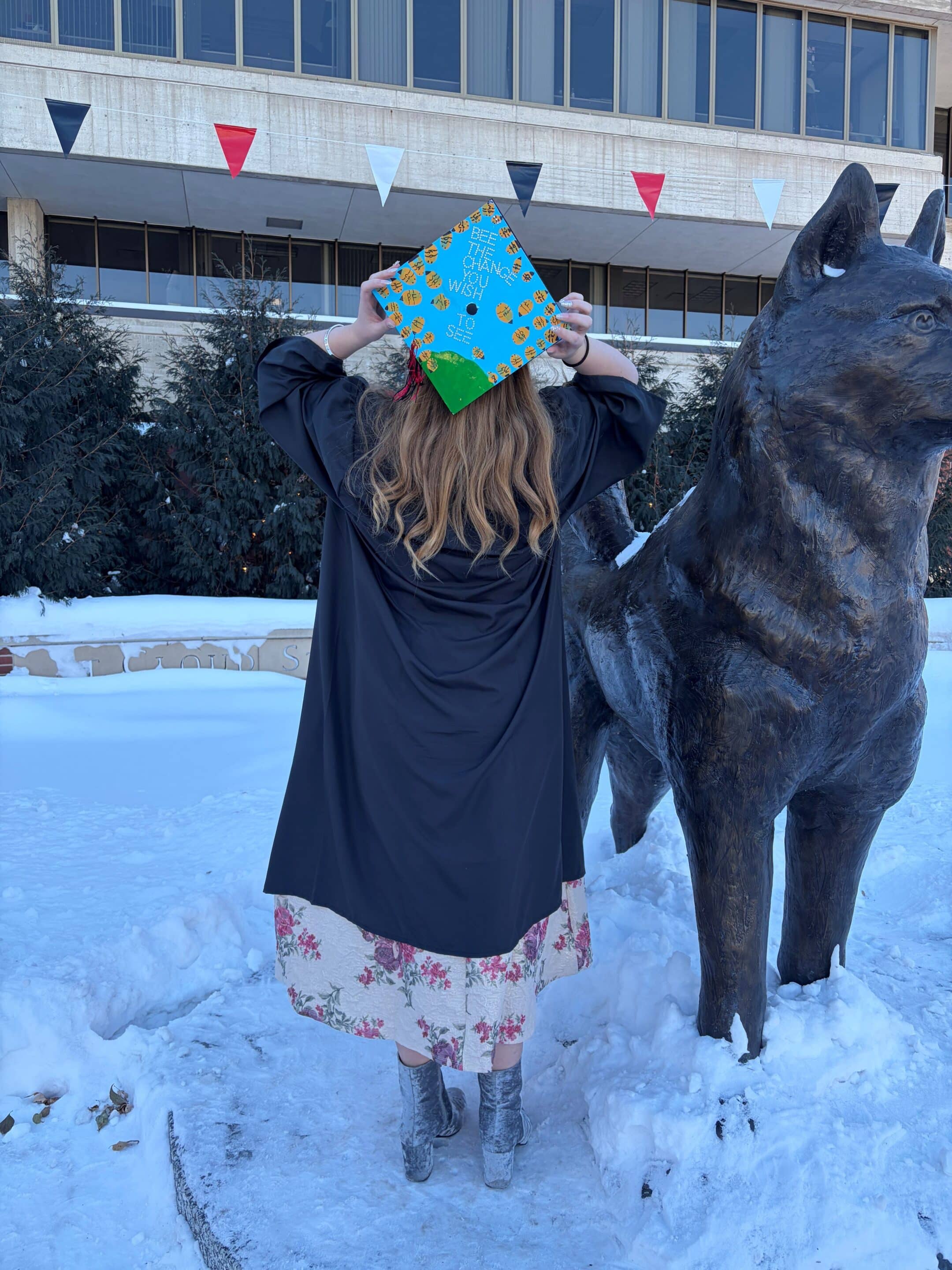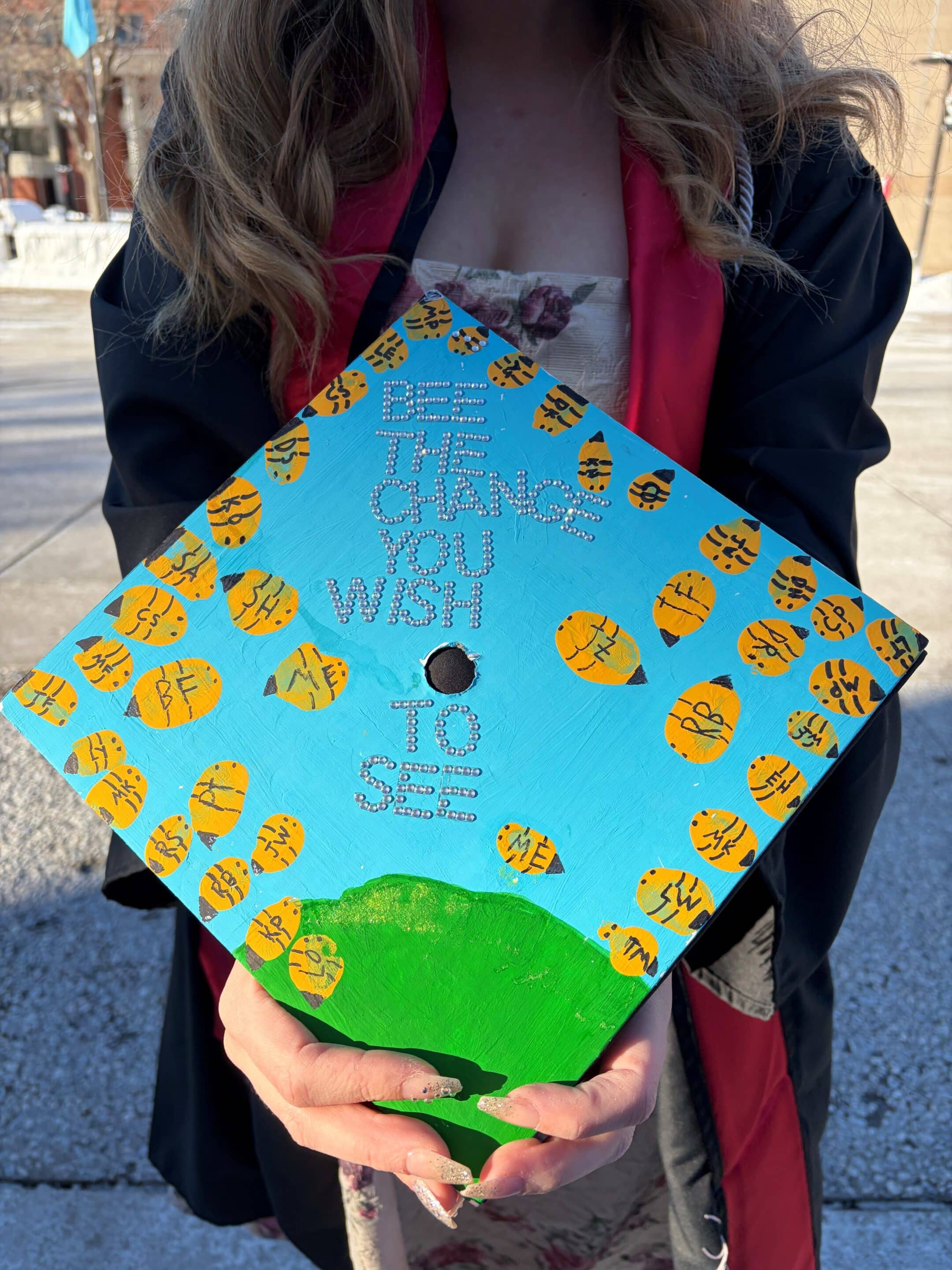

At WACOSA, our mission is driven by the powerful relationships between our staff and the individuals we serve, a connection beautifully illustrated by Peyton Herges, one of our Direct Support Professionals. In this interview conducted by Ann Kennedy, Marketing Director for WACOSA, Peyton reflects on her journey since arriving at WACOSA two years ago seeking hands-on experience — a journey she couldn’t have predicted would shape her so deeply. Today, she celebrates her graduation with a cap covered in colorful “bumblebees,” each a fingerprint from the individuals she supports — her clients — who continue to shape her journey.
How long have you been at WACOSA, Peyton?
Peyton: I have been at WACOSA for 2 years.
What was the inspiration behind having the WACOSA clients decorate your graduation cap? What does it symbolize to you?
Peyton: The inspiration behind having the clients decorate my cap was centered around the question that everyone gets at some point: “Why did you choose this field?” and while we all have endless stories and can write numerous essays about the reasons why, I decided to showcase the reasons why not only I chose this field but also why I love it so much.
I wanted to honor and showcase the people who have been integral to my journey. Working at WACOSA and with the people we serve has been such an enriching experience and the individuals I have worked with have helped me shape the direction I want to go in as an educator in and out of the classroom, and how the connection between K-12 and places like WACOSA may be different or similar and how to potentially move forward within the system to make the future stronger.
The quote I put on my cap, “Be The Change You Wish To See,” has resonated with me throughout my time at WACOSA and in general, as change is sparked by actions, even the small ones, over time. With WACOSA, the change happens every single day with both our clients and staff through not only our overall mission but also through everyday successes and challenges we may face.
Can you describe the experience of working with the clients on the graduation cap? Did you give them guidance? Are you working directly with them?
Peyton: Working with them on this design has been a wonderful experience! Before we started, I explained the purpose behind the project, and once I had explained, they were very eager to participate. I gave each person guidance on the location of their print on the cap and guided them through the process of how it would turn out.
Is there a specific decoration or design element from one of the clients that holds a special meaning for you? Why?
Peyton: The design element that holds a special meaning to me is the fact that all of the participants had an option between using their thumb, pinkie, or index finger to create their bumblebee. This created bees of many shapes and sizes, and this element stuck to me as it perfectly encapsulates how each of these people I support, just like their bees, come in all different forms to create one beautiful piece.
How did the clients react when you asked them to participate in such an important milestone for you?
Peyton: The clients were super excited about participating! Through building a relationship with each of my clients, the majority have known that I was working towards a degree, and they would even ask me questions about it. To have the individuals I have been working closely with throughout this timeline was a full-circle moment.
How has your education in Special Education shaped the way you interact with and support the people we serve at WACOSA?
Peyton: I have been able to draw many connections to my experiences at WACOSA and the special education classroom. Many of the experiences I have had in my classroom, I have been able to recall a point where a similar situation occurred, and what approaches I took, and evaluated the effectiveness of the response given in each setting. Conversely, the experiences I have had in my special education classroom have shaped the way I interact with each person by innovating new ways to modify and adapt certain types of material for each of their physical, emotional, and cognitive levels and needs.
What initially led you to WACOSA? What is the most rewarding, or perhaps the most challenging, aspect of your job here?
Peyton: Initially, before I heard about WACOSA, I had never thought about working with adults in a work setting, but I wanted to get hands-on experience with working with individuals with disabilities and broaden my horizons. It has opened me up to many perspectives and topics relating to special education/ disability services, and I have been able to create a basis for a wider understanding of disability from a lifespan perspective in relation to services received. The most rewarding part of my job is seeing each of the individuals I serve grow in their own ways.
What is the single most important lesson or perspective you’ve learned from working alongside people WACOSA serves?
Peyton: Relationships and time! Everything takes time, including relationships. Part of building that rapport with anyone is also being vulnerable at times. Sharing successes and points of trials helps build a rapport as the people you serve are going to respect you more when you are real, honest, and relatable with them.
What message would you like to share with other young people considering a career in special education or disability support services?
Peyton: Try different things and broaden your horizons! Each of us has different niches, and in the world of special education/disability support services, there’s an abundance of not only need but also opportunity in so many areas. Finding your niche comes with trial and error, but it’s up to you to explore it.
Peyton’s journey reminds us that at WACOSA, the impact of our work travels in both directions. While she provides essential support to her clients every day, they, in turn, have provided her with a lifelong perspective on the power of patience and human connection. As she moves forward with her degree, Peyton continues to embody the “change she wishes to see,” proving that when we invest in others, we all grow together.